
Vietnam is arguably the most frictionless country in Southeast Asia for solo travelers, provided you embrace the chaos of its transit systems and rely on local digital tools. After spending months navigating the length of the country alone, I have found that the most successful trips happen when you stop trying to book expensive private tours and instead learn to use the infrastructure that locals use every day. The country is remarkably safe, the Wi-Fi is faster than in most of Europe, and the social scene for independent travelers is diverse enough to accommodate both the party-seeking backpacker and the quiet digital nomad. If you are looking for a place where $40 a day buys you a comfortable lifestyle and a deep cultural immersion, this is it.
How to handle Vietnam E-visa and arrival logistics
The entry process for Vietnam has changed significantly over the last two years, and it is now much easier for solo travelers to stay longer without doing “visa runs.” As of late 2023, the 90-day E-visa is available to citizens of all countries. You should apply only through the official government portal (evisa.xuatnhapcanh.gov.vn). Avoid third-party agencies that charge double the $25 fee. The processing time is officially three working days, but I strongly recommend applying at least two weeks before your flight. I have seen travelers stuck at check-in counters because their middle name was missing from the PDF or because a weekend holiday delayed the approval. Print two physical copies of your visa; while some airports accept digital versions, others still demand paper.
Upon landing in Hanoi or Ho Chi Minh City, your first priority is connectivity. While you can use an e-SIM like Airalo, it is often more expensive and less reliable than a local physical SIM. I recommend Viettel, which has the best coverage in rural areas like Ha Giang or the Central Highlands. A 30-day data plan with 4GB of daily 4G data usually costs around 200,000 VND ($8). You can find official kiosks in the arrivals hall. Do not leave the airport without cash. While credit cards are gaining ground in malls and high-end hotels, Vietnam remains a cash-dominant society. Use the ATMs from TPBank or VPBank, as they generally have higher withdrawal limits and lower fees for foreign cards. Having 2,000,000 VND in your pocket is a safe baseline for your first 48 hours of food and local transport.
Mastering transportation as a solo traveler in Vietnam
The single most important app you will download for your trip is Grab. It functions like Uber but includes motorbikes (GrabBike), which are essential for solo travelers. A car ride across Hanoi might take 40 minutes and cost $6, while a GrabBike will weave through traffic in 15 minutes for $1.50. It eliminates the need to haggle with taxi drivers and ensures you aren’t scammed by a rigged meter. Always check the driver’s plate against the app before hopping on. For long-distance travel, you have three main choices: the Reunification Express train, sleeper buses, or domestic flights.
| Transport Mode | Estimated Cost | Best For | Pros/Cons |
|---|---|---|---|
| Sleeper Bus | $10 – $20 | Budget travelers / Short hops | Pro: Cheap, door-to-door. Con: Cramped for anyone over 5’10”. |
| Train (Soft Sleeper) | $30 – $60 | Scenery and safety | Pro: Social, more legroom. Con: Slower than buses. |
| Domestic Flight | $40 – $90 | Saving time | Pro: Very fast. Con: Misses the rural landscape. |
If you choose the train, I recommend the “Soft Sleeper” class. You share a cabin with three other people, which is a great way to meet locals or other travelers in a controlled environment. For buses, look for “VIP 20-cabin” buses rather than the standard 40-seat sleepers. These offer a fully flat bed and a privacy curtain, which is a game-changer for solo female travelers who want a bit of personal space during an overnight journey. Booking these through platforms like 12Go.asia or Baolau is straightforward and avoids the confusion of local bus stations where English is rarely spoken.
Where to go in Vietnam: A solo-friendly regional breakdown
Most solo travelers start in the North and head South, or vice versa. If you only have two weeks, I suggest focusing on the North and Central regions. Hanoi is the cultural heart of the country and serves as the perfect base for solo exploration. The Old Quarter is walkable, and the cafe culture provides a natural “third space” where you can sit with a book or laptop without feeling out of place. From Hanoi, the Ha Giang Loop is the premier adventure for solo travelers. If you cannot ride a semi-automatic motorbike yourself, you can hire an “Easy Rider” (a local driver). This is a highly social experience; you will likely end up in a convoy with ten other solo travelers, staying in homestays and sharing family-style dinners every night.
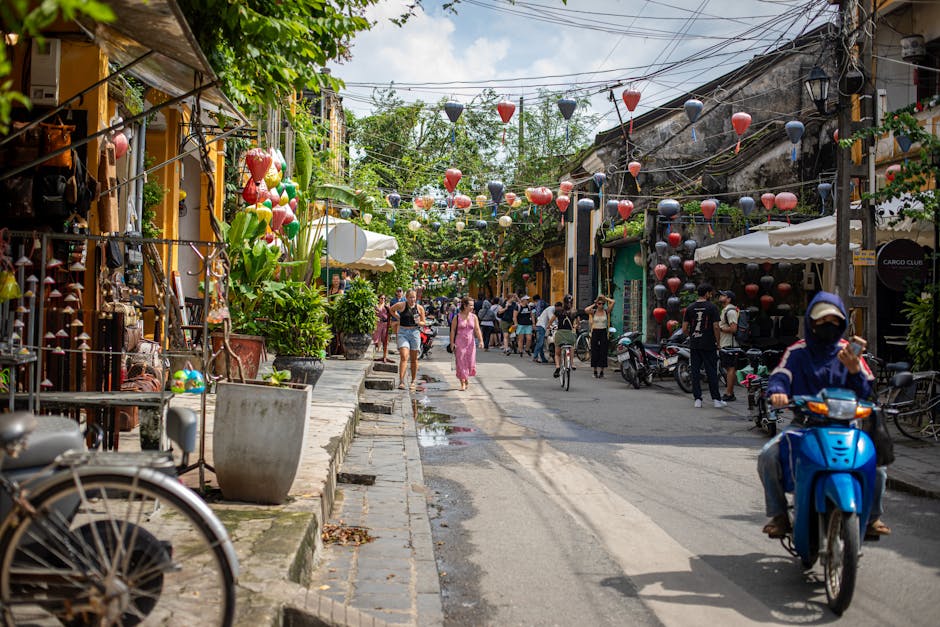
Central Vietnam offers a much slower pace. Hoi An is the most popular stop, famous for its tailoring and lantern-lit streets. While it is touristy, it is incredibly safe and easy to navigate on a bicycle. Just 30 minutes away is Da Nang, which has become a hub for solo digital nomads. It offers a beach city vibe with modern amenities and a growing community of long-term travelers. If you are traveling alone, Da Nang is often more comfortable than the chaotic southern hub of Ho Chi Minh City (HCMC). HCMC is a sprawling metropolis that can feel overwhelming for a first-timer. It is excellent for foodies and nightlife, but the traffic and noise level are significantly higher than in the North. If you do go, stick to District 1 or District 3 for your first few nights to stay within walking distance of the major sites.
Is Vietnam safe for solo travelers and how to avoid scams?
Vietnam is statistically very safe regarding violent crime, but petty theft and opportunistic scams are common in high-traffic tourist areas. In Ho Chi Minh City, bag snatching by thieves on motorbikes is a real risk. Never walk near the curb with your phone out or your bag hanging loosely on one shoulder. I have seen phones swiped right out of people’s hands while they were checking Google Maps. Keep your phone secured with a lanyard or step deep into a shop doorway before pulling it out. In Hanoi, the most common annoyance is the “shoe shiner” scam. Someone will point at your shoes, claim they are broken, and start “fixing” them before you can say no, then demand $20. A firm “No” and walking away immediately is the only way to handle this.
Aggression is rarely the answer in Vietnam. The culture places a high value on “saving face.” If you find yourself in a dispute over a price, staying calm and smiling while sticking to your original agreement is far more effective than shouting.
Solo female travelers generally report feeling very safe, even at night. However, it is wise to use Grab for all late-night transport rather than walking alone in dimly lit areas or taking unverified street taxis. If you are worried about the social aspect or safety of dining alone, the street food stalls are your best friend. Sitting on a low plastic stool on a busy sidewalk is the ultimate equalizer; no one cares if you are alone, and the turnover is so fast that there is no pressure to move on. For a more structured social environment, joining a walking food tour on your first night in a new city is a great way to get your bearings and meet people without the pressure of a hostel bar.
Accommodation strategies for the independent traveler
The accommodation landscape in Vietnam is incredibly diverse. While many solo travelers default to hostels, the rise of “Flashpacker” hostels and high-quality homestays offers better value for those who want sleep over parties. In Hanoi, look for hostels in the Hoan Kiem district that offer “pod” style beds. These provide a level of privacy that traditional bunks lack. A solid recommendation is Little Hanoi Hostel (approx. $12/night), which is known for being social but not a “party” hostel. The pro is the excellent free breakfast and local advice; the con is that rooms can be quite small.
For a more authentic experience, especially in places like Sapa or the Mekong Delta, choose a homestay. These are often small, family-run guesthouses. You will get a private room for $15-$25, but the highlight is the “family dinner.” For a small fee, you eat with the hosts and other guests. This is the best way to avoid the loneliness that sometimes creeps into solo travel. If you need a break from the social grind, Vietnam has an abundance of boutique hotels. In Hoi An, you can find 4-star hotels with pools for $35 a night. I often use Agoda over Booking.com in Vietnam, as it frequently has better rates for the Asian market and more accurate reviews of the Wi-Fi speed, which is a critical metric if you are working on the road.
Budgeting and essential gear for a solo trip

Vietnam remains one of the best value-for-money destinations globally. A solo traveler can comfortably see the country on $35 a day if staying in hostels and eating street food. If you prefer private rooms and mid-range restaurants, $60-$70 a day allows for a very high standard of living. When budgeting, remember that internal flights are cheap if booked in advance, but last-minute tickets can spike during Tet (Lunar New Year) or other national holidays. Avoid traveling during Tet if possible, as prices triple and the entire country effectively shuts down for a week.
Regarding gear, your choice of luggage will dictate your mobility. I highly recommend the Osprey Farpoint 40 (~$185). It is the gold standard for solo travel because it fits in most overhead bins on VietJet or Bamboo Airways flights, saving you checked bag fees. The pro is the durable harness system that makes walking between bus stations easy; the con is the lack of a dedicated, padded laptop compartment on older versions. Another essential is a Grayl Geopress water filter (~$100). Tap water in Vietnam is not potable. While plastic bottles are cheap, a filter bottle saves you money and reduces the massive plastic waste problem the country faces. Lastly, bring a lightweight rain jacket. Whether you are in the humid South or the misty North, a sudden downpour is almost guaranteed, and the cheap plastic ponchos sold on the street tear within minutes.
Vietnam rewards the curious and the patient. It is a country that requires you to lean into the noise rather than fight it. By using local apps, staying in social homestays, and keeping your wits about you in the big cities, you will find that traveling solo here is not just easy—it is the best way to experience the sheer energy of the place. You aren’t insulated by a tour bus window; you are right there on the back of a motorbike, smelling the woodsmoke and the fish sauce, which is exactly where you want to be.